

Followers
YouTube monetization requirements: the exact numbers for 2026
YouTube monetization requirements in 2026: ads need 1,000 subscribers and 4,000 watch hours, fan funding needs 500. The exact rules and how to get there.
YouTube · Views
YouTube wants 4,000 public watch hours in 12 months before it turns on ads. Here is the exact rule, what does not count, the maths, and what moves it.

YouTube’s rule is 1,000 subscribers plus 4,000 qualified public watch hours in the last 12 months (YouTube Help, Partner Program overview). That is what opens ad revenue. There is a second route, 1,000 subscribers plus 10 million public Shorts views in 90 days, but this guide is about the hours.
4,000 hours is 240,000 minutes. A 10-minute video watched to the end by 24,000 people gets there. So does a 20-minute video where the average person watches half of it, with the same 24,000 views. Longer videos that hold attention get there with fewer views.
The fastest way is not more views. It is more minutes per view. Below is the exact rule, what YouTube leaves out, the arithmetic, and what works.
YouTube Help’s page on the Partner Program lists the threshold and what counts toward it. Here it is in one table.
| Watch time from | Counts toward 4,000 hours? |
|---|---|
| Public long-form videos | Yes |
| Public livestreams that stay up as videos | Yes |
| Private videos | No |
| Unlisted videos | No |
| Deleted videos | No |
| Ad campaigns | No |
| YouTube Shorts watched in the Shorts feed | No |
| Livestreams that are unlisted, deleted or not kept as video on demand | No |
The word “qualified” in YouTube’s rule means public long-form only. That is the whole list. If a video is private, unlisted or gone, its hours are gone with it.
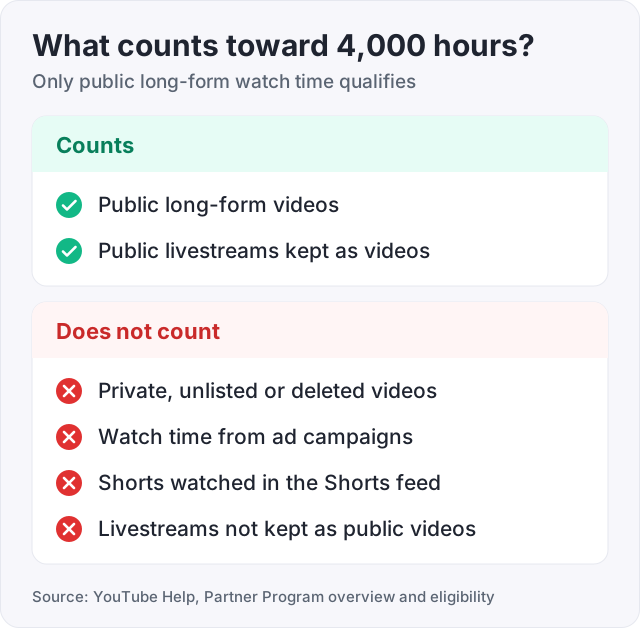
No. Watch time from Shorts in the Shorts feed does not count toward the 4,000 hours (YouTube Help). Shorts have their own path, the 10 million views in 90 days. If your channel is mostly Shorts, you are on the other track, and the two do not add together.
Only public long-form videos and public livestreams that stay up as videos. Every hour a viewer spends on those counts, whether they came from search, the home page or a link. The one traffic source YouTube names as excluded is ad campaigns (YouTube Help).
The maths is simple, and it is worth doing for your own channel.
4,000 hours is 240,000 minutes. Divide 240,000 by the average minutes a viewer watches per view, and you get the views you need.
| Video length | Average watched | Minutes per view | Views needed |
|---|---|---|---|
| 10 minutes | 100 percent | 10 | 24,000 |
| 20 minutes | 50 percent | 10 | 24,000 |
| 5 minutes | 60 percent | 3 | 80,000 |
| 30 minutes | 40 percent | 12 | 20,000 |
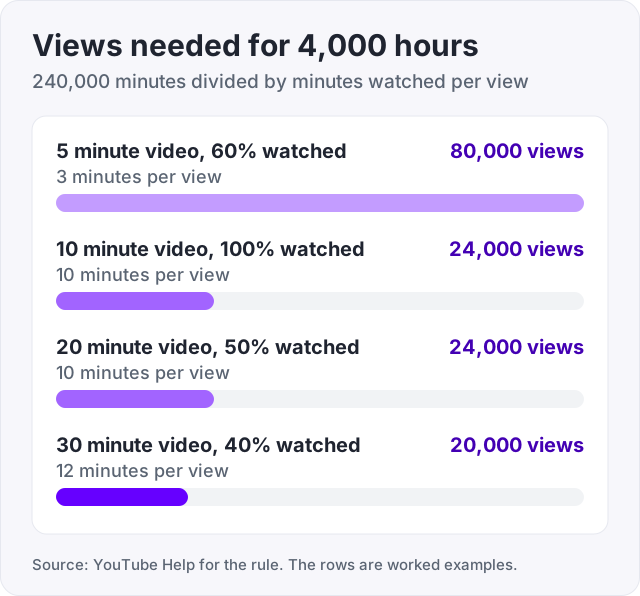
These are examples, not a promise. Your real number comes from YouTube Studio. Open Analytics, look at average view duration, and divide 240,000 by it.
Two things stand out. Short videos need far more views, because each one gives you only a few minutes. And retention matters more than length. A 30-minute video nobody finishes does worse than a 12-minute video people stay for.
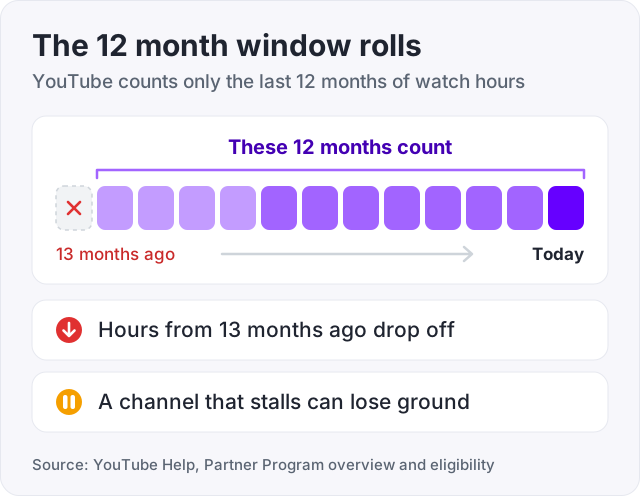
It depends on views times minutes, so there is no fixed answer. The one hard limit is the window. YouTube counts only the last 12 months, and the window rolls (YouTube Help). Hours you earned 13 months ago drop off. A channel that stalls can lose ground while it waits.
Open YouTube Studio and click Earn. That tab shows your subscriber count and your watch hours toward the threshold (YouTube Help).
If watch hours are not updating, give it a day. Then check whether recent uploads were public and long-form. Unlisted uploads add nothing, and so does anything played in the Shorts feed.
YouTube’s page on how recommendations work says the system looks at what viewers watch and how long they stay (YouTube, How YouTube Works). Everything below follows from that.
Make longer videos that hold attention. Not padded ones. A 12-minute video with a reason to stay beats a 4-minute video, and it beats a 25-minute one that drags.
Win the first 30 seconds. Most people who leave do so early. Say what the video gives them, then give it. Save the channel intro for later, or drop it.
Build playlists. A playlist plays the next video on its own. One viewer can give you three videos of watch time instead of one.
Use end screens. Point to the video a viewer is most likely to want next. That keeps them on your channel instead of someone else’s.
Publish on a schedule. Regular uploads give returning viewers a reason to come back, and a reason to stay when they do.
Keep livestreams public. A public stream that stays up as a video keeps earning hours after it ends. An unlisted or deleted one earns nothing (YouTube Help).
Tip: sort your videos in YouTube Studio by watch time, not views. The videos at the top are what your audience stays for. Make more of those.
Our guide on how to get more views on YouTube covers the view side. This guide is about minutes per view, and that is the part most people skip. Good titles and tags help too. Our free YouTube tag generator gives you a starting list.
Two shortcuts come up all the time. Neither works.
Ad campaigns. YouTube’s rule excludes watch hours from ad campaigns (YouTube Help). You can run Google Ads to a video and get real people watching it. Those hours are real. They still do not count toward the 4,000.
Bot views. YouTube’s fake engagement policy says that artificially increasing views, through automated systems or by serving videos to unsuspecting viewers, is not allowed. Channels that do it can have content removed or be terminated (YouTube Help, Fake engagement policy). Bot views are also removed from the count, so they add nothing even before the penalty.
There is a lower tier worth knowing. 500 subscribers plus 3,000 watch hours (or 3 million Shorts views) plus 3 uploads in 90 days opens fan funding features, but not ads (YouTube Help). Full details are in our YouTube monetization requirements guide.
We sell YouTube views, 1,000 for $12.95. They are delivered through YouTube’s own ad system. That means a real person sees your video as an ad placement and watches it.
Because they are ad-delivered, YouTube’s rule applies to them. Watch hours from ad campaigns do not count toward the 4,000-hour threshold (YouTube Help). So do not buy views from us, or from anyone, to reach monetization. It will not work, and we would rather say so than take the order.
What ad-delivered views do is raise the public view count so a new video does not sit at 9 views. That is a first impression fix, not a monetization tool. Our guide on what counts as a view on YouTube explains how the public count and watch time differ.
The same honesty applies to YouTube subscribers, 100 for $34.95. They raise the visible subscriber number. YouTube’s Partner Program review checks for spam subscribers and removes them, so they are not a way to pass the 1,000 subscriber bar either.
It depends on how long people watch. 4,000 hours is 240,000 minutes. Divide that by the average minutes watched per view. A 10-minute video watched fully needs 24,000 views. A 20-minute video where people watch half needs the same 24,000. A 5-minute video where people watch 3 minutes needs 80,000 views.
No. Watch time from Shorts in the Shorts feed does not count toward the 4,000 public watch hours (YouTube Help). Shorts have their own route, 1,000 subscribers plus 10 million public Shorts views in the last 90 days. The two routes are separate, so Shorts views and long-form hours do not add together.
There is no fixed answer, because it is views times minutes watched. The one hard limit is the window. YouTube counts only the last 12 months, and the window rolls, so hours older than that drop off (YouTube Help). A channel that uploads longer videos on a steady schedule gets there faster than one that posts short videos now and then.
First check the Earn tab in YouTube Studio, which shows your hours toward the threshold (YouTube Help). Give it a day. Then check what you uploaded. Unlisted and private videos add nothing. Shorts watched in the Shorts feed add nothing. A livestream you deleted or left unlisted adds nothing. Only public long-form videos and public streams kept as videos count.
No. YouTube Help lists private, unlisted and deleted videos as excluded from qualified public watch hours. If you have a video that is doing well while unlisted, switching it to public makes its watch time count from that point on. The same applies to livestreams. An unlisted stream adds nothing until it is public.
Not in any way that counts. YouTube excludes watch hours from ad campaigns, which covers ad-delivered views like the ones we sell. Bot views break the fake engagement policy and can get a channel terminated (YouTube Help). Anyone selling watch hours that count toward the Partner Program is selling something YouTube removes.
The facts in this guide come from the places below. We check them again each time the guide is updated.
The services and free tools this guide talks about, with the prices you actually pay.
More YouTube guides from the same team.
Followers
YouTube monetization requirements in 2026: ads need 1,000 subscribers and 4,000 watch hours, fan funding needs 500. The exact rules and how to get there.

Views
From August 24, 2026 a YouTube view counts the moment a video starts to play. Here is how own views, replays, frozen counts and engaged views work.

Views
YouTube recommends videos people click and keep watching. Here is what moves views, how Shorts fit in, and what bought views do and do not do.