

Followers
YouTube monetization requirements: the exact numbers for 2026
YouTube monetization requirements in 2026: ads need 1,000 subscribers and 4,000 watch hours, fan funding needs 500. The exact rules and how to get there.
YouTube · Views
YouTube does not pay per view. It pays a 55 percent share of ad revenue. Most creators earn $1 to $30 per 1,000 views. Here is why, and what Shorts pay.
YouTube does not pay per view. It pays a share of the money advertisers spend on your videos, and only once your channel is in the YouTube Partner Program. Creators keep 55 percent of the ad revenue on long videos (YouTube Help).
In dollars, Influencer Marketing Hub’s 2026 figures show most monetized creators earn between $1 and $30 per 1,000 views from ads alone. That is a wide range, and the topic of the channel is most of the reason.
This guide explains RPM and CPM in plain words, shows the ranges by niche, covers Shorts, and does the blunt maths on whether bought views can ever pay for themselves. They cannot.
Two numbers get mixed up all the time. They measure different things.
CPM is what advertisers pay per 1,000 ad impressions. It is the advertiser’s number. An advertiser might pay a $10 CPM to show an ad 1,000 times.
RPM is what you receive per 1,000 views on your channel. It is your number. It is lower than CPM for two reasons. YouTube keeps its 45 percent share of long-form ad revenue (YouTube Help). And not every view shows an ad, but every view still counts in the 1,000.
So when someone asks how much YouTube pays per view, RPM is the answer they want. Everything below is RPM.
Influencer Marketing Hub’s 2026 figures group channels into three bands. The topic decides the band, because advertisers pay more to reach some audiences than others.
| Niche band | Examples | RPM per 1,000 views |
|---|---|---|
| Low | Entertainment, gaming, music | $1 to $3 |
| Average | Most other topics | $5 to $10 |
| High | Finance, business, software, tech | $20 to $30 or more |
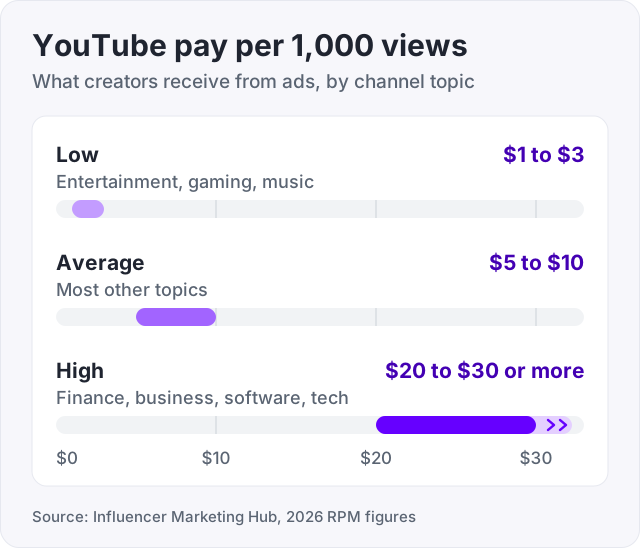
Google’s own search summary gives $1 to $5 per 1,000 views as typical for many niches. That fits the low and average bands. The high band is real, but it is small, and it is made of topics where the viewer might spend a lot of money after watching.
The same ranges scale up. Influencer Marketing Hub’s 2026 table gives these figures, depending on niche.
| Views | Ad earnings |
|---|---|
| 1,000 | $1 to $30 |
| 100,000 | $100 to $3,000 |
| 1 million | $1,000 to $30,000 |
A million views is a big number and a small cheque on a gaming channel. The same million on a finance channel can be a year’s salary. That is the whole story of YouTube pay in one row.
Five things move RPM, and most of them are not in your control.
Topic. The bands above. A viewer researching software is worth more to an advertiser than a viewer watching a prank.
Audience country. Advertisers in the United States, the United Kingdom, Canada and Australia pay more (Influencer Marketing Hub). A channel with the same views but a mostly different audience earns less.
Engaged views, not public views. YouTube’s earnings use engaged views, not the number under the video (YouTube Help). From August 24, 2026 the public count counts a play the moment it starts, so the gap between the two got wider. Our guide on what counts as a view on YouTube explains each count.
Ad blockers. A view with no ad shown earns nothing, but it still counts in the 1,000. Views from ad blockers, from regions with no ads, or on videos with limited ads earn little or nothing.
Limited ads. A video that runs limited ads earns little or nothing from those views, even with the same count.
Tip: your real RPM is in YouTube Studio once you are monetized. Use it instead of any calculator. It already accounts for your topic, your audience and your ad-blocked views.
Yes, but the system is different and the money is much smaller.
Ad revenue from the Shorts feed goes into a Creator Pool. That pool is split among creators by their share of Shorts views, and creators keep 45 percent of their share (YouTube Help, Shorts monetization policies). Long videos pay 55 percent of the ads on your own video. Shorts pay 45 percent of a slice of everyone’s ads.
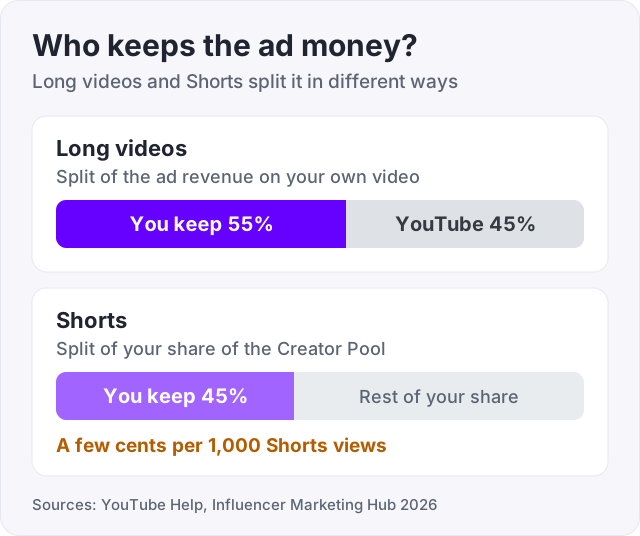
Influencer Marketing Hub reports that this works out to a few cents per 1,000 Shorts views. Shorts are good at reaching new people. They are not good at paying for it.
None of the numbers above apply until your channel is in the Partner Program. For ad revenue, YouTube Help sets these thresholds.
There is also a lower tier at 500 subscribers that opens fan funding, like memberships and Super Chat, but not ads. Our guide on the YouTube monetization requirements has every rule, including the ones about AdSense and 2-Step Verification.
Every online calculator does one sum. Take the views, divide by 1,000, multiply by an RPM. The RPM is a guess, and that guess is the whole result.
You can do the same with the Influencer Marketing Hub ranges.
Remember that the views in step one should be engaged views, which are fewer than the public count. So the real answer sits a little under whatever you worked out.
We sell YouTube views at 1,000 for $12.95, delivered through YouTube’s own ad system. Here is the maths, and it is not close.
At a typical RPM of $1 to $5, 1,000 views earn $1 to $5 in ad revenue. You paid $12.95. Even at the very top of the Influencer Marketing Hub range, the money only arrives on engaged views, and an ad-served view is not the same as an engaged one. On top of that, no video earns anything until the channel is in the Partner Program, which most channels buying views are not.
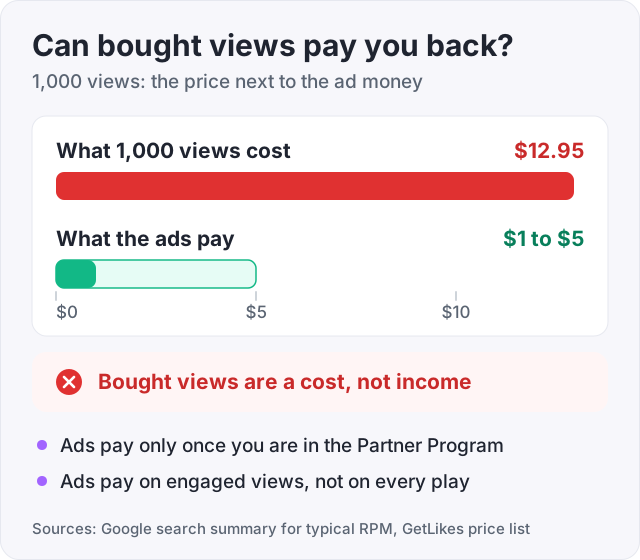
So bought views are not an investment that returns money. They are a cost. What you get for it is a public view count that does not look empty on a new video or a new channel. That is a real thing to want, and it is the only thing we can promise. The same goes for our YouTube subscribers at 100 for $34.95. They change how a channel looks. They do not change what it earns.
Watch out: anyone who tells you bought views will “pay for themselves” through ad revenue is either guessing or selling bot traffic. Bot views get removed (YouTube Help), and ad views earn less than they cost. There is no version of this where the maths works.
Do the sum with your real numbers once a month. It stops being a guess after the first cheque.
It depends on the topic and where the viewers live. Influencer Marketing Hub puts most monetized creators between $1 and $30 per 1,000 views from ads alone in 2026. Entertainment, gaming and music sit at $1 to $3. The average is $5 to $10. Finance, business, software and tech reach $20 to $30 or more. The Google search summary gives $1 to $5 as typical for many niches.
The 2026 table from Influencer Marketing Hub puts 1 million views at $1,000 to $30,000, depending on niche. A gaming channel with a $1 RPM earns about $1,000. A finance channel with a $30 RPM earns about $30,000. The same million views can be worth 30 times more on one channel than another, which is why nobody can give one number.
Use the RPM ranges from Influencer Marketing Hub. At a $5 RPM you need about 2 million engaged views a month. At $1 you need 10 million. At $30 you need about 333,000. Those are engaged views, the count YouTube uses for earnings, not the public number under the video (YouTube Help). Topic and audience country decide which end you sit at.
Yes, but far less than long videos. Ad revenue from the Shorts feed goes into a Creator Pool. It is split by the share of Shorts views each creator has, and creators keep 45 percent of their share (YouTube Help, Shorts monetization policies). Influencer Marketing Hub reports this works out to a few cents per 1,000 views. You also need to be in the Partner Program first.
RPM stands for revenue per 1,000 views. It is what you actually receive for every 1,000 views on your channel, after YouTube takes its share and after views that showed no ad are counted in. CPM is different. It is what advertisers pay per 1,000 ad impressions. RPM is always lower than CPM, and it is the number that matters to you.
Every calculator is doing the same sum. Views divided by 1,000, times an RPM it guesses for your niche. You can do it yourself with the Influencer Marketing Hub ranges: 100,000 views at $1 to $30 per thousand is $100 to $3,000. The guess is the weak part. Your real RPM is in YouTube Studio once you are monetized, and nothing else is more accurate.
The facts in this guide come from the places below. We check them again each time the guide is updated.
The services and free tools this guide talks about, with the prices you actually pay.
More YouTube guides from the same team.
Followers
YouTube monetization requirements in 2026: ads need 1,000 subscribers and 4,000 watch hours, fan funding needs 500. The exact rules and how to get there.

Views
From August 24, 2026 a YouTube view counts the moment a video starts to play. Here is how own views, replays, frozen counts and engaged views work.

Views
YouTube recommends videos people click and keep watching. Here is what moves views, how Shorts fit in, and what bought views do and do not do.