

Algorithm & timing
Best time to post on Instagram, day by day (2026 data)
The best time to post on Instagram is midweek afternoons, per Sprout Social 2026 data. Here is the day-by-day table and how to find your own time in Insights.
YouTube · Algorithm & timing
The best time to post on YouTube is Sunday at 10 a.m. for videos and Friday at 4 p.m. for Shorts, per Buffer 2026. See every day and find your own time.

The best time to post on YouTube depends on what you post. Buffer looked at about 1.8 million videos in 2026. Long videos did best on Sunday at 10 a.m. Shorts did best on Friday at 4 p.m. Buffer gives every time in your audience’s local time.
Those are averages across other people’s channels. Other big studies pick other days. vidIQ found that the upload hour barely changes a video’s views after 30 days. And YouTube gives every channel a chart of when its own viewers are online. That chart beats any study.
Below are the full tables for videos and Shorts, how much the day really matters, how to read your own chart, and what YouTube says about publish time.
For long videos, the best times are in the morning and around noon. For Shorts, they are in the evening. Here are the top three slots for each day from Buffer’s 2026 study, best first. All times are your audience’s local time (Buffer).
| Day | Long videos (Buffer, 2026) | Shorts (Buffer, 2026) |
|---|---|---|
| Monday | 9 a.m., 10 p.m., 7 a.m. | 8 p.m., 5 p.m., 6 p.m. |
| Tuesday | 9 a.m., 11 a.m., 8 a.m. | 8 p.m., 9 p.m., 7 p.m. |
| Wednesday | 7 a.m., 3 p.m., 5 p.m. | 7 p.m., 8 p.m., 9 p.m. |
| Thursday | 5 p.m., 6 p.m., 7 a.m. | 7 p.m., 8 p.m., 9 p.m. |
| Friday | 12 p.m., 11 a.m., 3 p.m. | 4 p.m., 6 p.m., 7 p.m. |
| Saturday | 12 p.m., 10 a.m., 3 p.m. | 7 p.m., 11 a.m., 6 p.m. |
| Sunday | 10 a.m., 9 a.m., 12 p.m. | 7 p.m., 8 p.m., 5 p.m. |
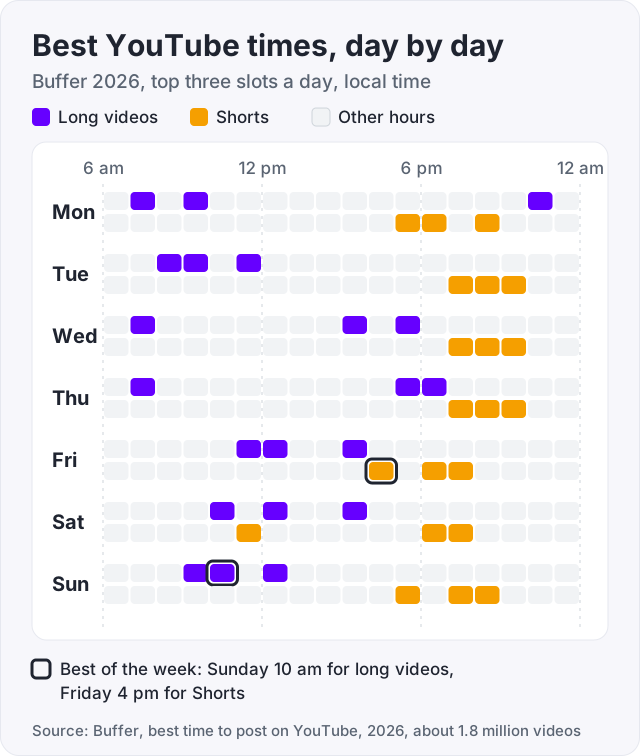
Sunday at 10 a.m. is the strongest slot of the whole week for long videos. Sunday is also the best day for them, then Tuesday and Monday. Wednesday and Thursday are the weakest. Buffer flags Thursday at 2 p.m. as one of the lowest slots of the week.
Use your viewers’ clock, not yours. If most of them live in London and you live in New York, a 10 a.m. Sunday slot is 5 a.m. for you for most of the year. Schedule it and sleep in.
The best time to post YouTube Shorts is Friday at 4 p.m., with Friday at 6 and 7 p.m. next (Buffer, 2026). Across the whole week, Shorts did best in the evening, mostly between 6 and 11 p.m.
That is close to the opposite of long videos. Buffer found Shorts did worse from 12 to 5 p.m. on every day except Friday. The best days for Shorts were Friday, Saturday and Thursday. The weakest were Monday and Tuesday.
vidIQ gives similar advice. It suggests Friday evening for Shorts, with Tuesday and Wednesday evenings as a second choice. It also says never to post a long video and a Short within the same four hours.
So if you post both, a simple week could look like this. Put a long video up on Sunday morning. Post Shorts on Thursday, Friday and Saturday evenings.
Sunday is the best day to post long videos in two of the four big studies we checked. But the gap between days is small. vidIQ compared 40.2 million US uploads with each channel’s own average, and Sunday came out only about 3.5% ahead.
Here is what each study found, and what it looked at.
| Study | Data | Best day | Best time | Time zone used |
|---|---|---|---|---|
| Buffer (2026) | About 1.8 million videos | Sunday for videos, Friday for Shorts | Sunday 10 a.m., Friday 4 p.m. | Your audience’s local time |
| vidIQ (2026) | 40.2 million US long videos | Sunday, then Saturday | No clear best hour | US Eastern Time |
| SocialPilot (2026) | 301,000 videos from more than 27,000 channels | Wednesday to Friday | 2 to 4 p.m. on weekdays | Local time |
| AIR Media-Tech (2026) | 31,852 long videos from 301 channels, posted in 2025 | Friday, for mid-size channels | 12 p.m. UTC as the steadiest slot | UTC |
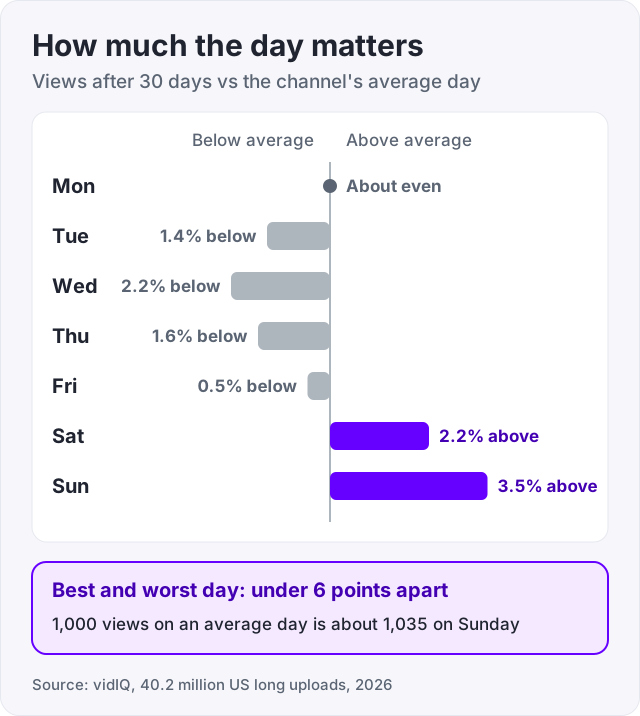
Look at the size of those bars. Sunday is about 3.5% above a channel’s average day. Wednesday, the worst, is about 2.2% below (vidIQ). So a video that would get 1,000 views on an average day gets about 1,035 on a Sunday, and about 978 on a Wednesday.
The hour matters even less. vidIQ found that exact upload times had little effect on views after 30 days. By day 30, the gap between the best and worst hours had shrunk to a few percent.
Each study sees different channels. SocialPilot sees videos posted through its own scheduler. vidIQ sees US uploads only. AIR sees the 301 channels in its own network. They also measure different things. Buffer and SocialPilot measure engagement. vidIQ and AIR measure views.
Your niche may matter more than the day. AIR found the best day beat the worst by 379% for Kids and Teens channels, but by only 35% for Education and Science. A study of everyone cannot see that.
YouTube shows every channel when its own viewers are online. The report is called When your viewers are on YouTube. It sits in YouTube Studio under Analytics, then the Audience tab (YouTube Help).
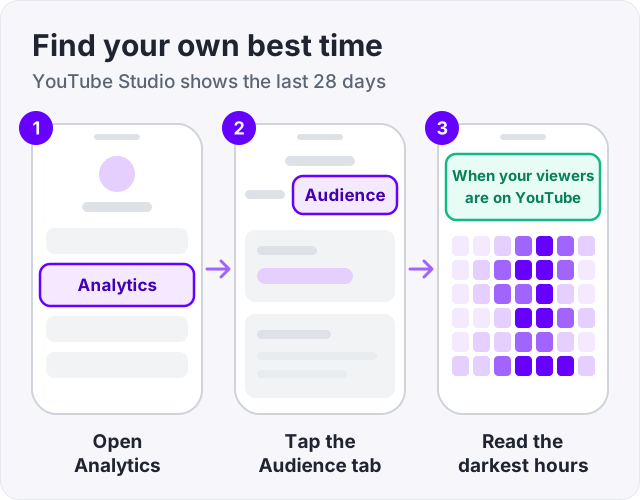
YouTube Help says the chart shows when your viewers were online across YouTube in the last 28 days. YouTube suggests using it to pick the day and time that is best for you to upload. It also suggests using it to plan a Premiere or a live stream.
The chart is a grid of days and hours. The darker a square, the more of your viewers are on YouTube at that hour. Find the darkest block on your busiest days.
Buffer adds one step. Publish one to two hours before your audience’s busiest window. That way the video is already live when the peak starts.
Check where your viewers live too. The Top geographies report on the same tab shows which countries bring your channel the most watch time (YouTube Help). If one country leads by far, post on its clock.
If your channel is new, the chart may not have much to show yet. Start with Buffer’s table, then switch to your own chart once it fills in.
Tip: you do not have to be awake at the right hour. YouTube Studio lets you set the date, time and time zone a video goes public (YouTube Help). Pick the time zone where most of your viewers live.
YouTube recommends videos based on how viewers react once a video is public. So the publish time mostly shapes the first hours, not the long run. Here is what YouTube has said on each part.
| What you might worry about | What YouTube says |
|---|---|
| Posting in off hours | The first boost in views may be slower. Total views usually even out over a few weeks or a month |
| Uploading early and waiting | Waiting 24 to 48 hours before you publish gives no benefit |
| Subscriber alerts | All notifications usually arrive within minutes. Personalized ones can arrive hours later |
| Posting many videos a day | A viewer gets at most 3 new video notifications from one channel in 24 hours |
| Premieres | Viewers who set a reminder get an alert about 30 minutes before, and again at the start |
The first hours. Rene Ritchie is YouTube’s Creator Liaison. He has said that posting in off hours, such as early morning, can make the first boost in views slower. Over a few weeks or a month, total views usually even out (Search Engine Land, 2024). vidIQ’s numbers back that up.
Waiting before you publish. A common creator tip says to upload a video and hold it private for a day or two. Ritchie said in 2025 that this does nothing. The recommendation system runs on how viewers behave, and that starts only once the video is public (Search Engine Journal). Uploading early is still useful for one thing. It gives the copyright and ad checks time to finish.
Notifications. Subscribers who chose All notifications usually hear about a new video within minutes. Those on Personalized may get the alert hours later, at the time YouTube thinks they are most likely to watch (YouTube Help). Each viewer gets at most 3 new video alerts from one channel in 24 hours. Post a fourth video that day, and some subscribers may get no alert for it.
Premieres. A Premiere lets viewers watch a new video together at a set time. YouTube makes a public watch page first, where people can set a reminder and chat. Those with a reminder get an alert about 30 minutes before and another when it starts. Shorts cannot be premiered (YouTube Help). Premieres are where your own chart helps most, because the point is that people show up at once.
What YouTube would not say. YouTube first showed creators this chart in 2020. At the time, its own team said it did not have the data to claim that posting at your busiest hour helps in the long run (Search Engine Journal, 2020).
Most timing problems come from a few habits, not from the wrong hour. Here are the ones the studies and YouTube’s own pages warn about.
We sell YouTube views from $12.95 per 1,000. They are delivered through YouTube ads, so real people are shown your video and choose to watch. Here is the honest note on how that fits with timing.
Bought views raise the public count. They make a new video look watched to the first strangers who find it. They will not make YouTube recommend your next upload. They do not count toward the watch hours you need for the Partner Program. And they do not change when your viewers are online.
A good slot and a strong first 30 seconds do more for reach than any number you can buy. Our guide on how to get more views on YouTube covers the parts that matter more than the clock.
The same test works on other apps, but the hours are different. See our guides on the best time to post on Instagram and the best time to post on TikTok.
It depends on the day and on what you post. For long videos, Buffer (2026) gives Monday 9 a.m., Tuesday 9 a.m., Wednesday 7 a.m., Thursday 5 p.m., Friday 12 p.m., Saturday 12 p.m. and Sunday 10 a.m. For Shorts it gives 7 or 8 p.m. most days, and 4 p.m. on Friday. Times are your audience's local time. Your own chart in YouTube Studio is more exact.
Friday at 4 p.m. is the top Shorts slot in Buffer's 2026 data, with Friday at 6 and 7 p.m. next. Across the week, Shorts did best in the evening, mostly between 6 and 11 p.m. Monday and Tuesday were the weakest days. vidIQ also suggests Friday evening for Shorts, with Tuesday and Wednesday evenings as a second choice.
Sunday, for long videos, in two big studies. Buffer (2026) ranks Sunday first, then Tuesday and Monday. vidIQ found Sunday about 3.5% above a channel's average day, with Wednesday the weakest at about 2.2% below. That gap is small. For Shorts, Buffer ranks Friday first, then Saturday and Thursday.
10 a.m. for long videos. It was the best slot of the whole week in Buffer's 2026 data, with 9 a.m. and 12 p.m. next. For Shorts on a Sunday, Buffer found 7 p.m., 8 p.m. and 5 p.m. work best. The times are in your audience's local time, so use their clock if most viewers live in another time zone.
Buffer (2026) gives 12 p.m., 10 a.m. and 3 p.m. for long videos on a Saturday, and 7 p.m., 11 a.m. and 6 p.m. for Shorts. Saturday is a middle day for long videos and the second best day for Shorts. vidIQ found Saturday uploads about 2.2% above a channel's average day after 30 days.
For long videos, Buffer (2026) gives 12 p.m., 11 a.m. and 3 p.m. on a Friday. Friday is the best day of the week for Shorts, with the top slots at 4 p.m., 6 p.m. and 7 p.m. If you post both formats, put the long video up around lunch and the Short in the late afternoon.
A little, and mostly in the first hours. YouTube's Creator Liaison, Rene Ritchie, said a video posted in off hours may get a slower start, but total views usually even out over a few weeks or a month. vidIQ's data agrees. By day 30, the gap between the best and worst upload hours had shrunk to a few percent.
Upload early if you like, but waiting does not help ranking. Rene Ritchie of YouTube said in 2025 that a 24 to 48 hour wait is no different from waiting 24 to 48 seconds. Recommendations run on how viewers react, and that starts only when the video is public. Uploading early still gives the copyright and ad checks time to finish.
The facts in this guide come from the places below. We check them again each time the guide is updated.
The services and free tools this guide talks about, with the prices you actually pay.
More YouTube guides from the same team.
Algorithm & timing
The best time to post on Instagram is midweek afternoons, per Sprout Social 2026 data. Here is the day-by-day table and how to find your own time in Insights.

Algorithm & timing
The best time to post on TikTok is Tuesday to Thursday, 2 to 6 p.m. per Sprout Social, or evenings per Buffer. Both tables, why they clash, and your own data.

Views
YouTube recommends videos people click and keep watching. Here is what moves views, how Shorts fit in, and what bought views do and do not do.