

Algorithm & timing
Best time to post on TikTok: what two big studies found
The best time to post on TikTok is Tuesday to Thursday, 2 to 6 p.m. per Sprout Social, or evenings per Buffer. Both tables, why they clash, and your own data.
Instagram · Algorithm & timing
The best time to post on Instagram is midweek afternoons, per Sprout Social 2026 data. Here is the day-by-day table and how to find your own time in Insights.

The best time to post on Instagram is midweek, in the afternoon. Sprout Social’s 2026 study puts the strongest windows on Tuesday from 1 to 7 p.m. and Wednesday from 12 to 9 p.m. The best days are Tuesday and Wednesday. The worst are Saturday and Sunday.
That study covers nearly 2 billion engagements across 307,000 profiles (Sprout Social, 2026). It is the best benchmark there is. It is still an average. Instagram itself says there is no universal best time, and your own followers have their own pattern.
So use the table below to start, then check your own Insights and run a two-week test. Both steps are covered here.
All times are in your audience’s local time, not yours. If most of your followers are in London and you are in New York, post on London time.
| Day | Best window (Sprout Social, 2026) |
|---|---|
| Monday | 2 p.m. to 4 p.m. |
| Tuesday | 1 p.m. to 7 p.m. |
| Wednesday | 12 p.m. to 9 p.m., plus 11 p.m. |
| Thursday | 12 p.m. to 2 p.m. |
| Friday | No peak window. Engagement tapers off in the afternoon |
| Saturday | One of the two worst days |
| Sunday | One of the two worst days |
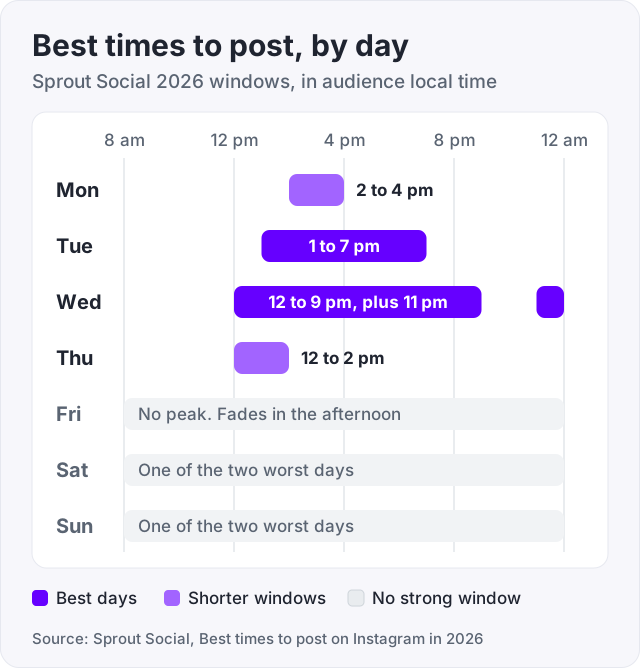
Google’s own summary of this data points to Wednesday around 11 a.m. to 12 p.m. as the single strongest hour. It gives Tuesday and Wednesday from 12 to 7 p.m. as the broad peak.
Sprout notes that results differ by industry. A restaurant and a software company do not share an audience, so they do not share a best hour. Treat the table as a starting point, not a rule.
Tuesday and Wednesday lead. Monday and Thursday follow, each with a shorter window. Friday fades through the afternoon. Saturday and Sunday come last (Sprout Social, 2026).
The pattern is a work week. People check Instagram on lunch breaks and after the afternoon slump, and they check it less when they are out on the weekend. If your audience does not work a normal week, expect your pattern to differ.
If you post three times a week, the simplest plan is Tuesday, Wednesday and Thursday, all in the early afternoon. Skip the weekend unless your Insights say otherwise.
Instagram ranks each post on its own. One of the signals it uses is popularity, meaning how many people are reacting and how fast (Instagram ranking explained). A post that gets likes, comments and saves in its first hour tells Instagram to show it to more people. A post that sits quiet gets shown to fewer.
That is why timing matters. Posting when your followers are online means more of them see the post while it is new. Their reactions arrive while Instagram is still deciding how far to push it.
It also means timing is only half the job. A post nobody wants to react to does not get saved by a good hour. Timing puts the post in front of people. The post has to do the rest.
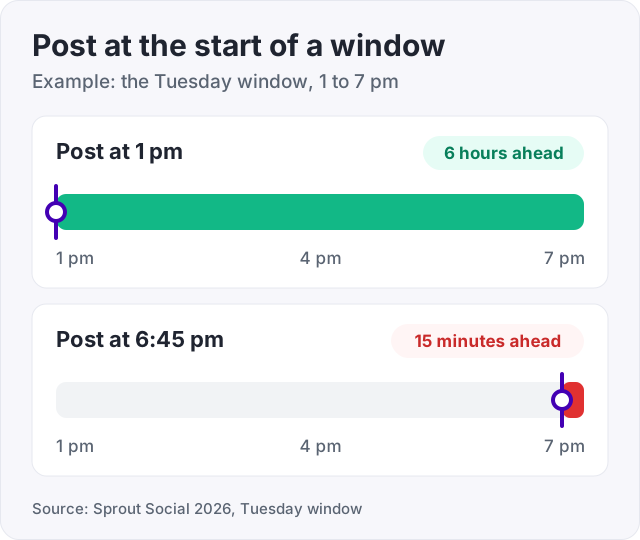
Tip: post at the start of a window, not the end. A post that goes up at 1 p.m. on Tuesday has six hours of high activity ahead of it. One that goes up at 6:45 p.m. has fifteen minutes.
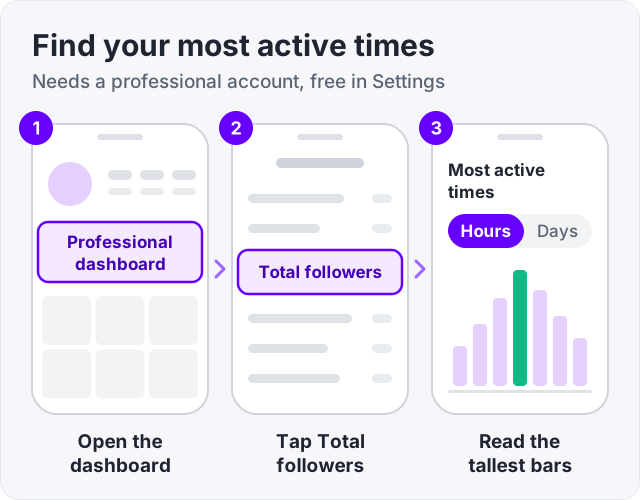
Instagram shows you when your own followers are online. You need a professional account, which is free to switch on in Settings.
Hours shows a bar for each hour of the day. Days shows a bar for each day of the week. The tallest bars are your best windows. Iconosquare’s guide on finding your best time walks through the same screen.
If you use a scheduling tool, Buffer also recommends best times per account based on that account’s own history (Buffer). It is the same idea with the math done for you.
Benchmarks and Insights get you close. A short test gets you the answer.
Keep the posts similar in quality, or the test measures the post and not the time.
The table above is built for Feed posts. Stories behave the same way because both go mostly to followers, and followers are online at set times.
Reels are different. Instagram shows Reels to people who do not follow you and keeps testing them for days. A Reel posted at midnight on a Sunday can take off on Wednesday. Timing still helps the first hour, but it matters far less. Our guide on how to get more views on Instagram Reels covers what matters more.
If you post on TikTok as well, the pattern there is not the same. See our guide on the best time to post on TikTok.
It will not rescue a weak post. Timing gets a post seen. It does not make people like it.
It will not beat a bad week. If you post once a month, no hour fixes that. Consistency matters more than the clock.
It will not stay fixed. Your audience grows and changes. The hour that worked in spring may not work in autumn, which is why the test above is worth repeating.
We sell Instagram likes from $2.95, and the honest use for them is the first hour. A post that shows some likes early looks worth a tap to the first real people who see it. For accounts that post often, automatic Instagram likes do the same on every new post, from $79.95 for 50 likes per post for 30 days.
What bought likes do not do is replace timing or content. Good timing plus a good post beats bought engagement on its own every time. Use them to give a good post a start, not to prop up one that is not working.
Do that for a month and you will know your best time better than any study can tell you.
It depends on the day. Sprout Social 2026 data gives Monday 2 to 4 p.m., Tuesday 1 to 7 p.m., Wednesday 12 to 9 p.m., and Thursday 12 to 2 p.m. Fridays taper off in the afternoon, and Saturday and Sunday are the weakest days. Times are your audience local time. Your own Insights will show a more exact window for your followers.
Midweek afternoons. Across nearly 2 billion engagements from 307,000 profiles, Sprout Social found the highest activity on Tuesdays from 1 to 7 p.m. and Wednesdays from 12 to 9 p.m. Google summary of the same data points to Wednesday around 11 a.m. to 12 p.m. as the single strongest hour. Lunch breaks and late afternoon are the pattern.
Tuesday and Wednesday, with Monday and Thursday close behind (Sprout Social, 2026). Saturday and Sunday are the worst days across the whole dataset. That does not mean weekend posts fail, only that fewer people react to them. If your audience is students or hobby accounts, check Insights, because your weekend may look different.
Between 2 and 4 p.m. in your audience local time (Sprout Social, 2026). Monday mornings are slower as people settle into the week. If you post once on Monday, aim for the early afternoon window and check reach in Insights after an hour to see whether it caught on.
There is no strong window. Saturday is one of the two worst days in the Sprout Social 2026 data, along with Sunday. If you have to post on a Saturday, use your own Insights to find the hour your followers are online and post then. For most accounts a good Wednesday post will beat a good Saturday post.
Less than for Feed and Stories. Reels are shown to people who do not follow you, and Instagram keeps testing them over days, not hours. A Reel posted at a bad time can still take off on day three. Feed posts and Stories go mostly to followers, so they depend on who is online right now.
The facts in this guide come from the places below. We check them again each time the guide is updated.
The services and free tools this guide talks about, with the prices you actually pay.
More Instagram guides from the same team.
Algorithm & timing
The best time to post on TikTok is Tuesday to Thursday, 2 to 6 p.m. per Sprout Social, or evenings per Buffer. Both tables, why they clash, and your own data.

Likes & engagement
Most posts get likes from 2 to 4 percent of followers. Here is what a good number looks like, what makes Instagram show a post to more people, and what fails.

Views
Instagram shows Reels mostly to people who do not follow you and ranks them on watch time and shares. Here is what counts as a view and what moves the number.